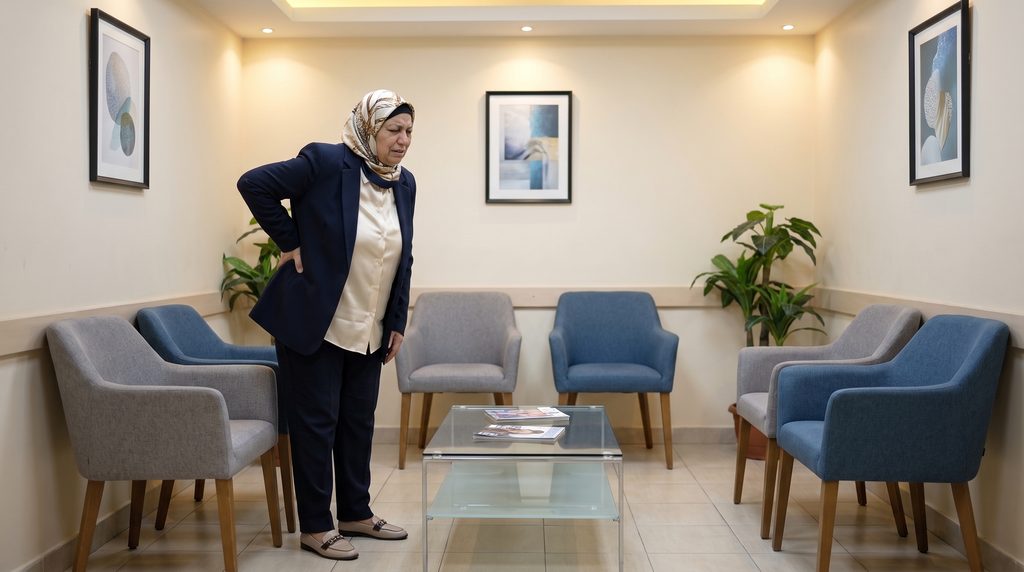
If you’re experiencing sharp pain that stretches from your lower back down to your leg, you’re definitely not alone.
Sciatica is considered one of the most common conditions we deal with at Be Active Clinic, affecting millions of people around the world and significantly impacting daily life.
In this article, we’ll take a detailed look at the real causes behind this painful condition, the symptoms you should watch out for, and the advanced treatment methods that have proven effective.
What is sciatica?
Sciatica is not a disease on its own, but rather a collection of symptoms that result from irritation or pressure on the sciatic nerve, which is the longest and thickest nerve in the human body.
This nerve starts in the lower back, goes through the buttocks, and runs down each leg all the way to the foot.
When this nerve is under pressure or inflamed, an imbalance occurs in nerve signal transmission, leading to the sharp pain the patient feels.
It’s important to understand that sciatica is a symptom, not a final diagnosis – the underlying causes can be multiple and require careful understanding.
The main causes of sciatica
1. Herniated Disc:
This is the most common cause of sciatica, and it happens when the gel-like tissue of a disc slips out and presses on the nerve roots responsible for the sciatic nerve.
A herniated disc often results from repeated strain or incorrect movements.
2. Pear Syndrome (Piriformis Syndrome)
The piriformis muscle is located in the buttocks and runs next to the sciatic nerve. When this muscle becomes tight or stiff, it can press on the nerve and cause pain.
This condition is very common among people who sit for long periods or play sports that heavily use the glutes.
3. Spinal canal narrowing (Spinal Stenosis)
As we get older, the channel through which nerve roots pass may narrow.
This narrowing can put pressure on the sciatic nerve and lead to sciatica symptoms.
4. Slipped vertebrae (Spondylolisthesis)
This is a condition where one vertebra slips forward over the one below it, which can put pressure on the nerve roots.
It often happens in athletes or as a result of wear and tear on the vertebrae.
5. Injuries and Accidents
Direct injuries to the lower back or buttocks can cause inflammation and swelling that put pressure on the sciatic nerve.
The symptoms you should watch out for
Distinctive pain
The patient may feel a sharp, burning pain in the lower back and buttocks, usually spreading to just one leg (rarely both legs).
The pain might be mild and annoying at first, but it can develop into very severe pain that disrupts daily life.
Numbness and tingling
You might feel strange sensations like tingling or ‘pins and needles’ in your leg and foot.
This happens when pressure on the nerve affects the way sensory signals are sent.
Muscle weakness
In the more severe cases, you might experience weakness in the affected leg muscles, making it hard to lift your foot or walk normally.
Difficulty moving
You might find it hard to sit or stand for long periods, bend over, or climb stairs.
These movements can make the pain a lot worse.
Accurate diagnosis
At Be Active Clinic, we use an advanced diagnostic approach that combines thorough physical exams with specialized medical imaging.
Physical exam
We do a number of simple but very effective tests, like the Straight Leg Raise test, where your leg is slowly lifted to determine the angle at which the pain starts.
Medical imaging
We might ask for X-ray scans to rule out bone problems, or an MRI to get a detailed picture of the spine and nerves.
Electrical studies
Nerve conduction and electromagnet tests might help us figure out how much the sciatic nerve is affected.
Treatment options
1. Conservative Treatment
This is the first option, which works in 90% of cases. It includes:
- Resting and reducing activities that increase pain
- Applying heat or cold to the affected area
- Taking painkillers and anti-inflammatory drugs under medical supervision
- Following a guided rehabilitation exercise program
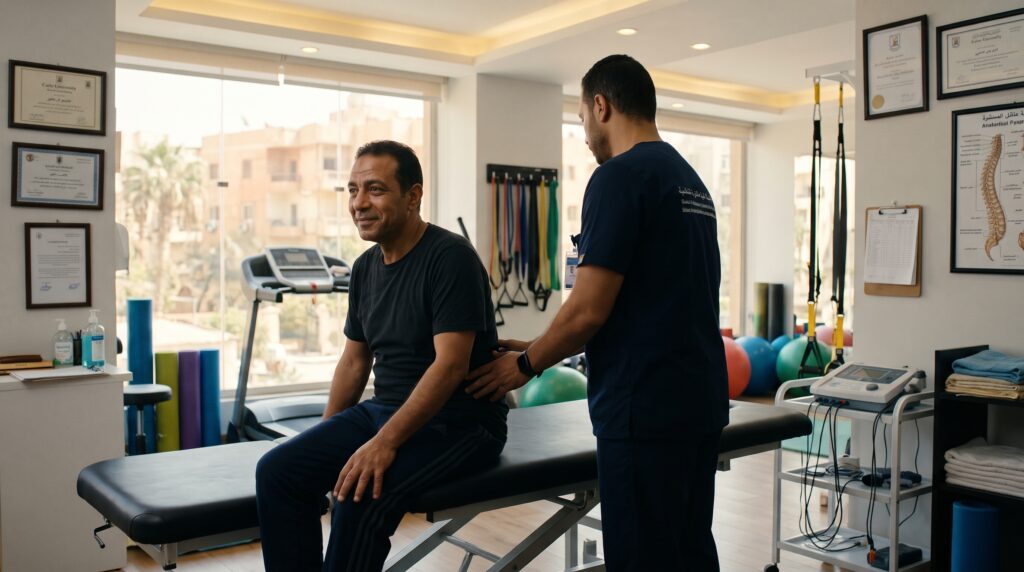
2. Physical and physiotherapy treatment
In our clinic, we use advanced techniques like:
- Stretching and strengthening exercises for the muscles around the sciatic nerve
- Manual therapy and therapeutic massage
- Electrotherapy, which helps reduce inflammation and pain
- Ultrasound therapy
- Cold laser therapy, which has proven very effective in reducing inflammation
3. Treatment with spinal traction device technology
The traction device (Spinal Decompression) works to relieve pressure on the nerve roots by applying precisely measured pulling forces, allowing the disc material to return to its proper place.
4. Therapeutic injections
In some cases, local steroid injections may be done to reduce inflammation around the nerve roots.
This is usually done under ultrasound guidance.
5. Surgical intervention
In very rare cases (less than 10% of cases), when all conservative treatments fail and the pain significantly affects quality of life, surgery may be considered.
Preventing sciatica
Prevention is better than cure. Here are some practical tips:
- Maintain good posture: Whether you’re sitting, standing, or sleeping, make sure your spine is properly aligned.
- Strengthen your back and glute muscles: Regular exercises keep these muscles strong and able to support your spine properly.
- Maintain a healthy weight: Excess weight puts more pressure on your spine and nerves.
- Avoid sudden movements and heavy lifting: If you need to lift something heavy, use your legs, not your back.
- Take regular breaks: If you’re sitting for long periods, get up every hour to stretch a bit.
- Do suitable sports: Swimming, yoga, and walking are excellent options to keep your back healthy.
Sciatica is a common condition, but it can be successfully treated. The key is early and accurate diagnosis and starting the right treatment at the right time.
At Be Active Clinic, we combine precise diagnosis with modern and advanced treatments to ensure the best possible results.
If you’re experiencing sciatica symptoms, don’t hesitate to seek specialized advice. Always remember
“We Keep You Moving”
our goal is to bring movement and comfort back to your life.